
My mistake on the numbering sequence—let’s get Article 11 right in its proper place!
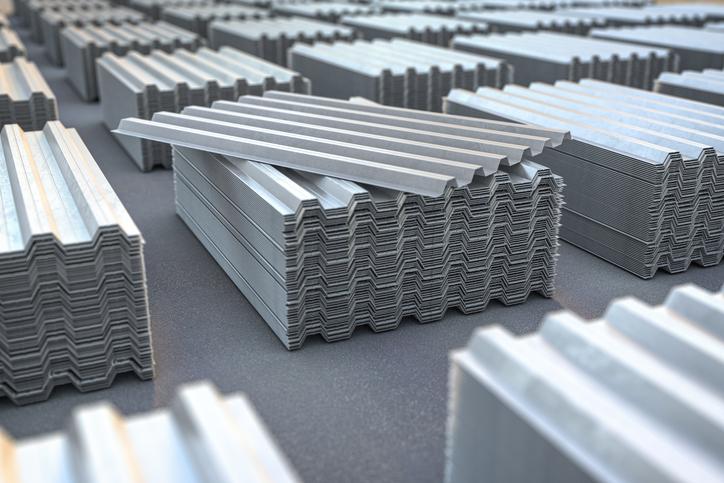
When designing agricultural structures—such as livestock barns, grain stores, and equipment sheds—or large industrial warehouses, roofing materials face relentless environmental stress. Between high wind loads, impact hazards, heavy rain, and corrosive internal atmospheres, roofing sheets must be both physically tough and cost-effective across vast surface areas.
While various roofing options exist, Hot-Dip Galvanized (HDG) corrugated steel sheets remain the dominant industry standard for agricultural and industrial facilities worldwide. Here is why they continue to lead the market.
1. Superior Resistance to Agricultural Ammonia & Chemicals
One of the severe hazards in livestock housing (poultry, cattle, and swine barns) is the buildup of ammonia gas ($NH_3$) generated from animal waste.
When ammonia combines with warm, humid air inside a barn, it forms a highly alkaline condensation on the underside of the roof.
-
Galvanized Steel: The pure zinc coating on galvanized sheets handles high-alkaline environments exceptionally well, protecting the steel substrate from atmospheric ammonia attack.
-
Alternative Metals (e.g., Galvalume / Aluminium-Zinc): Aluminium-zinc coatings react poorly with strong alkalis, causing the protective layer to break down rapidly in animal housing.
Key Spec Tip: For heavy livestock housing, specify heavy zinc coatings such as G90 ($275text{ g/m}^2$) or G115 ($350text{ g/m}^2$) to ensure long-term resistance to internal farm gases.
2. High Structural Impact Strength & Load Capacity
Industrial and farm roofs are routinely exposed to severe physical impacts: high winds, falling tree branches, hail, and heavy snow loads.
-
High Tensile Base Steel: Unlike solid aluminium sheets, which are relatively soft and easily dented by hail or maintenance foot traffic, galvanized steel sheets retain high structural tensile strength (typically $350text{ to }550text{ MPa}$).
-
Corrugation Engineering: Roll-forming galvanized sheet steel into corrugated or trapezoidal profiles significantly increases its structural rigidity, allowing for wider purlin spacing and reduced structural framing costs.
3. High Temperature Resistance & Fire Safety
Industrial facilities, processing plants, and farm workshops often present fire risks or operate under high radiant temperatures.
-
Non-Combustible Rating: Galvanized steel is non-combustible (Class A fire rating), preventing flame spread during structural fires.
-
Thermal Stability: Galvanized coatings withstand continuous exposure to temperatures up to $200^circtext{C}$ ($390^circtext{F}$) without peeling or degrading, making them suitable for high-heat industrial processing sheds where heat-sensitive coatings might fail.
4. Unmatched Cost Efficiency for Large-Scale Span Coverage
Covering tens of thousands of square meters of warehouse space requires strict budget optimization.
|
Roofing Material Option |
Relative Material Cost |
Structural Frame Requirement |
Long-Term Industrial Suitability |
|
Galvanized Steel (G90) |
Low to Moderate |
Standard purlin framing |
Exceptional (High impact & chemical res.) |
|
Aluminium Sheets |
High ($2timestext{ to }3timestext{ cost}$) |
Light framing |
Good (Lacks strength against hail/impact) |
|
Fiber Cement Sheets |
Moderate |
Heavy framing (Brittle) |
Moderate (Prone to cracking under impact) |
Galvanized corrugated sheets deliver an ideal balance: low initial purchasing cost per square meter combined with exceptional mechanical toughness that reduces structural support framing costs.
Summary Recommendation
For agricultural buildings, fertilizer storage sheds, and heavy industrial warehouses, G90 (Z275) Hot-Dip Galvanized corrugated steel sheets offer the optimal combination of ammonia resistance, structural impact strength, and overall lifecycle ROI.
Aluminium Sheet Kampala Uganga
